***
“That’s the old picnic area for Black folks.”
The National Park employee nodded to a patch of woods behind the Bluff Restaurant, a small shop on the Blue Ridge Parkway offering food, treats and a place to enjoy the scenery. The statement was both jarring and intriguing. Words from another era.
That single sentence led me back to that wooded area the following Sunday, where I navigated a tangle of natural obstacles down the hillside. A squatty rhododendron stretched a crooked limb across the abandoned walkway. A fallen tree, its trunk the diameter of a car tire, blocked the trail. The walkway, once a nice, paved stretch, was a jigsaw puzzle of broken asphalt slickened by a rain-soaked layer of rotting, autumn leaves.
Descending further, I found a scattering of crumbling cement picnic tables. Some were missing benches or chunks of the table itself. All were covered with a fluff of spongy moss. Stones were missing from the stack-rock water fountains. Chalky green paint flaked from the stall doors of the restrooms where signs once designated “White” and “Colored.” The entirety of the place reeked of decay. Nature seemed to be reclaiming what humans hoped would simply disappear. Old buildings, old leaves and old ideas.

| The old Woods Picnic Are behind the current Bluffs Restaurant Blue Ridge Parkway near Milepost 241 |
***
W. Avery Jones arrived in Winston-Salem, North Carolina in 1922. A native of Florida, Jones was a graduate of Florida A&M University and Howard University Law School. In Florida, he was a teacher and principal at Washington High School in Pensacola. After settling in Winston-Salem, he practiced civil law and became the general counsel for the Winston Mutual Insurance Company. Winston Mutual was a black-owned insurance company, founded to ensure that members of the African American community were not crippled by medical bills and that families were not left poverty-stricken from the loss of a family member. The company also served as a lending institution, offering loans to black-owned businesses that would otherwise be deemed “ineligible” by white-owned banks. Jones later became vice-president and then president of Winston Mutual.

| W. Avery Jones (from the 1970s) Photo from the Winston-Salem African American Archives |
Hosea VanBuren Price moved to Winston-Salem in the late 1920s. Price was a native of South Carolina. He moved to Washington D.C. to attend college at Frelinghuysen University, which was founded as a college for poor and working-class black students. Price later attended Robert H. Terrell Law School in Washington, D.C. This law school offered evening classes for working members of the African American community.
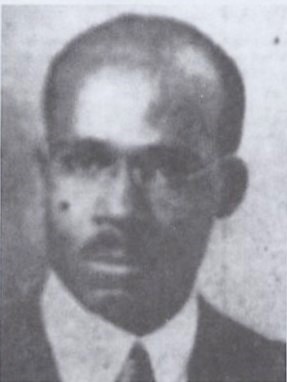
| Hosea Price Photo from the Winston Salem African American Archives |
Jones and Price relocating to Winston-Salem was due, at least in part, to the vibrant, African American communities within the city. These communities nourished and sustained several prominent educators, doctors and other professionals. Working class members of the community found employment with R.J. Reynolds Tobacco. John Jones, a long-time manager at RJR Tobacco recalls that black workers at Reynolds often had larger salaries than the professional members of the community.

| United Supreme Council of the Scottish Rite of Freemasons 1947 Winston-Salem members (seated L-R) Rev. R.P. Person, Phil W. Jeffreys, E.M. Mitchell, Dr. J.D. Quick, T.F. Poag (standing L-R) Dr. W.F. Meroney, Richard Moss, T.C. Cunningham, W. Avery Jones, D.W. Massey, Percy Rivera Photo: Society of the Study of Afro-American History |
This professional community was woven together through fraternal organizations, churches, and college alumni groups. Many were actively involved with the National Association for the Advancement of Colored People (NAACP). Jones and Price served as members of the North Carolina chapter of the NAACP’s Legal Redress team. By the 1940s, the NAACP identified the segregated state and national parks of the South as “The Achilles Heel” of Jim Crow laws. The Legal Redress committee of the NAACP speculated that these areas could be challenged without stirring up widespread opposition from the white population.
After a decade in the community, Jones and Price would become partners in a law firm. The year was 1941.
***
On Sunday, July 27, 1941, in what would be referred to in the modern activist vernacular as “direct action,” Attorneys Hosea Price and Avery Jones led a caravan of six cars from Winston-Salem to the Blue Ridge Parkway in Alleghany County, North Carolina. They were a party of five African American business and professional men who were accompanied by their wives and children – 30 people in total. They arrived at The Bluffs picnic area (now known as Doughton Park) where they were met by a park employee, Emerson Petty. Petty told them that the picnic tables they were about to use were “not available to colored people.” They were told they would have to use the tables across the Parkway in what became known as The Woods Picnic Area.
The group refused to leave.
Price and Jones were 42 and 49 years of age on that Sunday afternoon in 1941. Their interaction with Petty, and subsequent letter to the National Park Service(NPS) superintendent, offers a portrait of two confident men who were accustomed to speaking with authority to those in authority. William Fulton, a long-time employee of Winston Mutual Insurance recalls working for Avery Jones in the 1960s and 70s. “You never had to wonder where Lawyer Jones stood on an issue,” Mr. Fulton recalls. “Lawyer Jones always spoke his mind.”
This directness may have been a little unnerving to Petty, who likely had very few interactions with black folks in his mountain community. So, Petty went to get a supervisor.
R. Morrison King was a 1938 graduate from Davidson College with a degree in math and physics, as well as a member of the advanced ROTC program. This combination made him a near perfect fit for his supervisory role with the Civilian Conservation Corps Camp NP-21 near Laurel Springs, N.C.

| Richard Morrison King From the Davidson College Quips and Cranks 1938 |
King arrived at the Bluffs where the stalemate continued. In his report of the incident, he wrote:
“I accompanied Petty to the area and met the group there. They flatly refused to go to area No. 1[the Woods picnic area], part of which had been set aside for them. They inquired as to the penalty if they refused to leave. When told they might be cited for disorderly conduct they seemed well pleased and were apparently eager to have the matter tried in Federal Court. This would seem to indicate that the entire affair was planned so as to bring the issue to a head.”
He went on to list the group’s three primary objections to the segregated policy:
“…They claimed, as United States citizens, the equal right to any and all facilities within the Parkway. Further they state that since ‘segregation of the races is illegal out-of-doors they resented being shoved around.’ Their final and most strongly emphasized point was their loyalty to the United States government. Their spokesman states emphatically that no Negro in the United States would stoop to sabotage, espionage, or other subversive activities. He described the Negro race as eager to make any sacrifice for their country. He went on to say that in times of ‘national stress’ this great Democracy must pull together and smother all racial prejudice.”
King assured the group he would take their complaints to his superiors and, with that, the group dispersed. In his account, King described the group as “…orderly, quiet, but firm.”
***
The twisting ribbon of roadway that became the Blue Ridge Parkway was fraught with challenges from its very inception. The original plan called for the scenic road to travel through Tennessee, then into Virginia. North Carolina Congressman Robert Doughton of Alleghany County, Chair of the powerful U.S. Congressional Ways and Means Committee, had a different vision.
The locally told story is that, in 1935, President Franklin Roosevelt came to Doughton requesting his support for the Social Security Act and other New Deal programs. Doughton responded casually that he sure would like to see that new scenic road come through North Carolina. That subtle negotiation led to the passage of the Act, and the Blue Ridge Parkway being anchored in North Carolina.

| Congressman Robert Doughton (standing left) looks on as President Franklin D. Roosevelt signs the Social Security Bill |
A drive along the Parkway reveals the natural obstacles that had to be overcome. Crews from the Civilian Conservation Corps blasted granite to notch the road into mountain sides and bridges were built over creeks and rivers. Even today, the parkway is an engineering marvel.

| Blue Ridge Parkway construction Photo from Records of the Bureau of Public Roads |
The less obvious challenge faced by the Department of the Interior was how to build facilities through this rural, southern landscape where Jim Crow laws had reinforced racial division for decades. In 1896, the U.S. Supreme Court ruling, Plessy v. Ferguson, upheld the legality of separate, but equal, facilities for racial and ethnic groups. While the Plessy case stemmed from separate railroad cars, this ruling was applied broadly to many public facilities. As the country struggled to recover from the Great Depression, construction costs would go up considerably if the Parkway was to have two sets of “separate but equal” facilities.
While the Department of the Interior developed blueprints for segregated campgrounds and picnic areas, they were slow to implement these plans. On the surface, the justification was that there were few African Americans with motor vehicles in the 1930s and 40s. Therefore, logically, there would be little demand from citizens who lacked motorized transportation. The Advisor on Negro Affairs for Department of The Interior was North Carolina native, W.J. Trent, Jr.. Trent challenged this policy:
“Usually, upon presentation of the idea that it is necessary to provide facilities for Negro use in these parks,” he [Trent] said “the first reply ready to hand is ‘When there is sufficient demand by Negroes for facilities in these areas, then they will be provided.’”

| W.J. Trent, Jr. |
Jones, Prices, and the others demonstrated that not only was a there demand, abut that they also demanded equal access.
***
Research has shown that eyewitness accounts are notoriously inaccurate. How events are processed and recalled by individuals can vary greatly. However, that was not the case with the incident at the Bluffs picnic area that afternoon in 1941. Jones and Price wrote a letter the following day to the Director of the National Park Service. Their account of the interaction was virtually the same as King’s letter. After being threatened with a criminal charge of disorderly conduct (though they challenged King to identify their disorderly behavior), they emphasized:
“We then stated to the Warden that we thought it best to make a test case of the matter and agreed voluntarily to submit to arrest or citation in order that the validity of this rule might be determined.
“We wish to say for Warden King that we were [sic] [he was] very courteous in his attitude toward us and at no time threatened us or attempted to get rough. He left us with the understanding that he would take this matter up with his superior officer…”
Both letters ended up on the desk of Harold L. Ickes, the United States Secretary of the Interior.
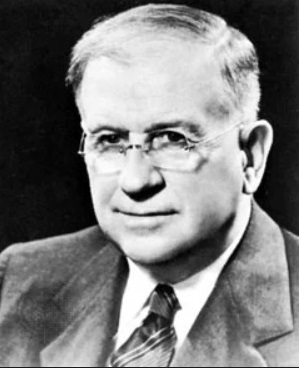
| Secretary of the Interior Harold L. Ickes 1933-1946 Photo from Library of Congress |
At the picnic area on that July afternoon, the wardens [park rangers] were operating under a 1940 memo from acting National Park Service superintendent, Stanley W. Abbott. There, Abbott referenced a 1939 directive concerning the development of segregated facilities along the Blue Ridge Parkway. Abbott’s memo gave direction to rangers on how to handle situations involving African American visitors to the Park.
“It is important that the Ranger Service show every courtesy to white and negro visitors, and effect should be made to keep white and negro visitors reasonably segregated in various use areas, but with the least possible attention being drawn to the problem. No signs are to be erected except on stall doors within the comfort stations until further study has been made of this problem when the need becomes emphasized.”
On August 5, 1941, U.S. Secretary of the Interior Ickes, responded by letter to Jones and Price. In the letter, Secretary Ickes explained:
“The approved development plan for ‘The Bluffs’ area of the Blue Ridge Parkway provides for three picnic areas. Two of these have been completed and, pending the completion of the third next summer, a portion of one of the completed picnic grounds had been designated for use by colored people. As the third picnic ground will not be completed until next summer, however, one of the two that have been completed will be designated immediately for use by both white and colored people. The employees of the National Park Service assigned to the section of Parkway which includes ‘The Bluffs’ are being so advised.
“Accordingly, a situation such as the colored people from Winston-Salem experienced on July 27 [1941] should not develop again. This is in accordance with the policy which I have approved for the development of ‘The Bluffs’ one picnic area will be designated for use by colored people only, one for use of white people only, and one for use by both white and colored people.”
Instead of tackling the fundamental question of legitimacy concerning segregated facilities, Secretary Ickes fell back to the notion of “separate but equal” and ordered that attention not be drawn to the problem. He explained that once the third picnic area was built and designated for African American use only, a situation like that that occurred on July 27, 1941 “should not develop again.”
***
During the war years and on into the early 1960s, Jones and Price continued to serve and represent their community. In 1942, Price defended a black man for raping a white woman. The defendant, William Mason Wellman, was convicted based on an eyewitness account from the victim and sentenced to death. Price appealed the conviction. As Wellman was strapped in the electric chair, word was received that another man had confessed to the crime. The governor offered a stay of execution and Wellman’s conviction was overturned in 1943.
Price vigorously argued for black administrators to manage Kate Bitting Reynolds Memorial Hospital in Winston-Salem. In 1945 black student nurses went on strike over the management of “Katie B.” Price wrote, “The hospital is filthy, dirty, nasty and not conducive to health. I do not believe that the donors [Will Reynolds] intended it to be run as it is.” In 1946, the management of the hospital was turned over to a black administrator.
Price was also instrumental in drawing attention to disparities in the salaries of white and Black teachers. In 1952, he argued a case before the U.S. Supreme Court challenging the exclusion of black jurors from court cases.
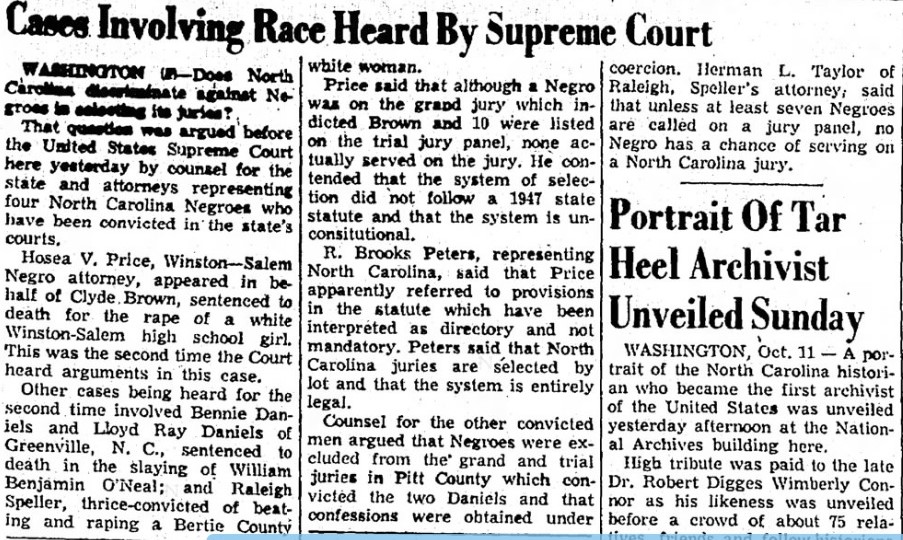
| From The Robesonian October 14, 1952 |
In 1963, Price was appointed to represent Marion Frank Crawford. Crawford escaped from prison in South Carolina where he was serving a 20-year sentence for assault. In Winston-Salem, he was later charged with raping and murdering an 8-year-old girl. Both Crawford and the victim were African American.
This case turned the white and black communities against Price. He received death threats for representing Crawford. In a newspaper interview, Price attributed his wife’s fatal heart attack to the stress of the public sentiment in this case. Price’s law practice virtually disappeared, leading him to accept a role as a public defender for indigent clients.
In 1982, Price was awarded the distinguished service award by the Forsyth County (North Carolina) Bar Association. When Price began practicing law, African American attorneys were not allowed to be members of the association. When this award was presented, Price was made a full member of the association retroactively to 1946.

| Hosea Price Photo from the Chapel Hill News August 4, 1982 |
Jones also continued to serve his community as a civil attorney. He was the general counsel for the Safe Bus Company, which provided transportation for the underserved black communities in Winston-Salem from 1926-1972. In 1968, it was the largest Black owned and operated transportation company in the world. At the time of his death in 1976, Jones was president of Winston Mutual Insurance.
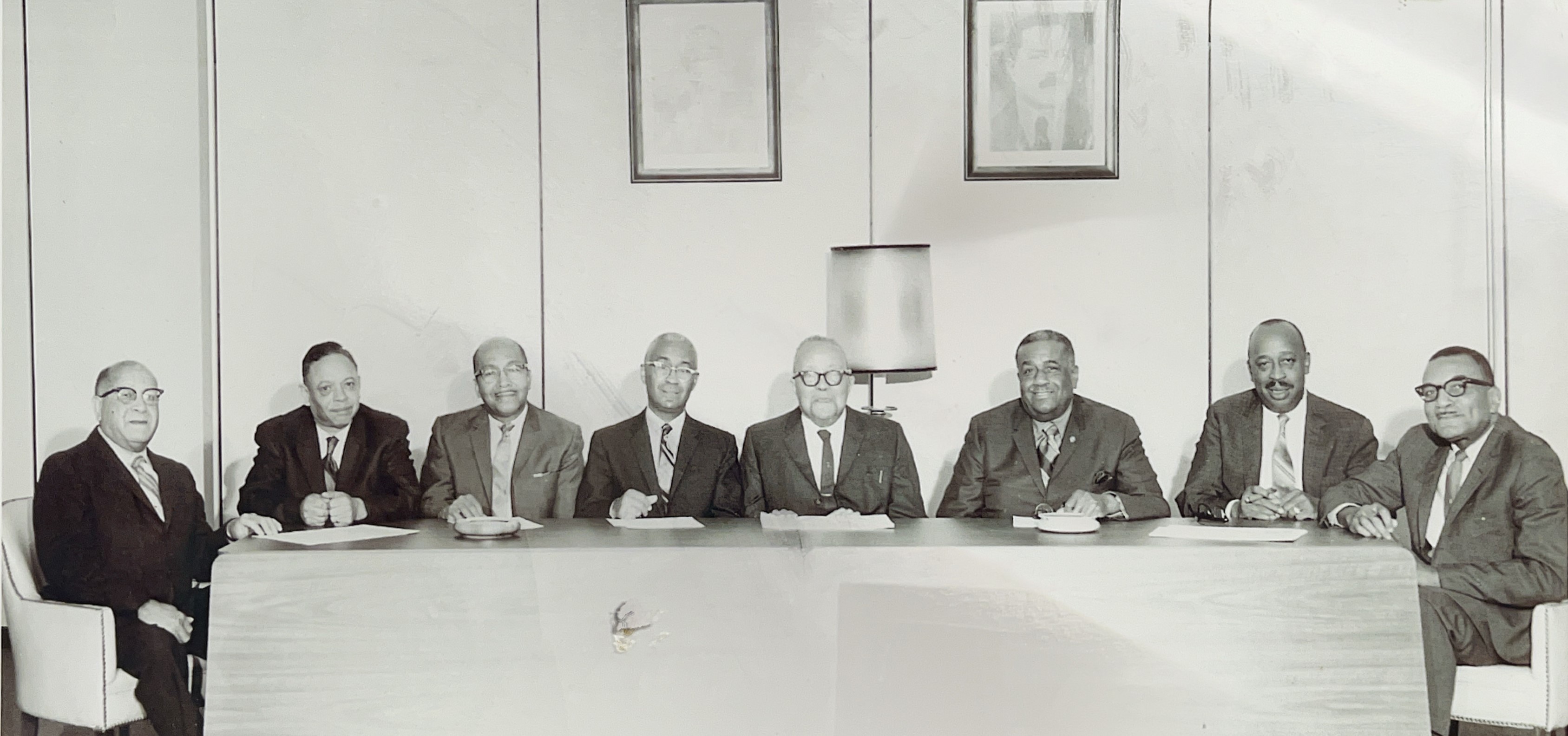
| Winston Mutual Insurance board of directors – 1970 (L-R) Andrew McKnight, Walter Hairston, Rumor Oden, Amos Harper W. Avery Jones, G. Casmo Hill, J.Q. Falls, Clarence Hill Photo from the Winston-Salem African American Archives |
Both men were active in the faith community. Price and his family were among 11 other founding members of St. Benedict the Moor Catholic Church in Winston Salem. That church later included a private school for black students. The church is still active today serving both the African American and Hispanic community and will celebrate its 85th anniversary in 2025.
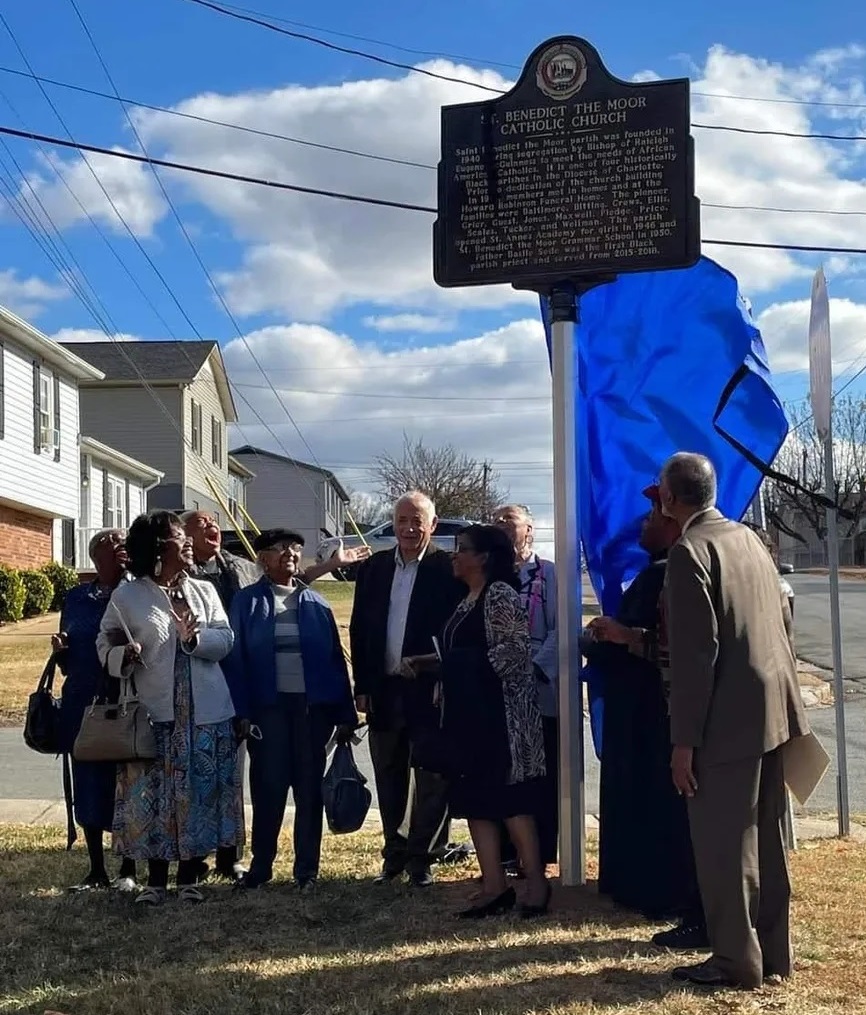
These men spent decades chipping away at segregation and racial inequality. They supported their local and broader communities in ways that empowered the powerless and gave voice to those who were not otherwise heard. Their dedicated work contributed to health care, economic stability, education, and legal representation of their neighbors.
Jones and Price were able to instigate the confrontation at The Bluffs in July 1941 because they were prominent, successful professionals from a prosperous, flourishing Black community. Their expertise in law and confidence in speaking with authority to authority allowed them to state their case factually and respectfully, while clearly demonstrating the moral flaw in the NPS policy at the time. Their lifetime of pursuit of social justice is reflective of the decades-long quest for equality by many others both in and out of the formal civil rights movement.
***
In 1945, four years after the letter from Jones and Price crossed his desk, the Department of the Interior Secretary Harold Ickes issued a bulletin mandating desegregation in all national parks. Yet, across the country, especially in the rural South, state and municipal parks continued to operate segregated facilities. This legacy continues to impact park visitation today. The National Park Service estimates that only 4%-6% of the visitors to the country’s 431 national parks are African American. Coincidentally, the 6% number also reflects the number of African American employees of the National Park Service.
A 2018 report identified three leisure constraints that inhibit park visitation by people of color: limited socioeconomic resources, cultural factors, and white racial frames.
Many of our national parks require travel for visitation. Accommodations and concessions in and around national parks can be costly. For those with limited economic resources (regardless of skin color or ethnicity), this becomes a barrier to entry.
Outdoor recreation has different values within cultural groups. When faced with a legacy of exclusion, many people of color may not have developed a history of positive outdoor experiences. In fact, the opposite may be true – outdoor spaces may feel dangerous.
The management of our parks often has a white framing. The programs presented, the development of campgrounds and picnic areas, and recreational opportunities are frequently planned through the lens of a white experience.
In 2017, President Barack Obama issued a memorandum, “Promoting Diversity and Inclusion in Our National Parks, National Forests, and Other Public Lands and Waters.” This memo aimed to address historical exclusionary practices across our public lands, promote a more diverse and inclusive workforce, and purposefully develop programming to create a more inclusive outdoor experience for all people.

| President Obama at Yosemite National Park Photo from dailymail.co.uk/news |
It should not be lost that this call to action was made from arguably the highest position in American government, by the first Black man to hold it. Men like Hosea Price and Avery Jones spent decades chipping away at segregation and racial inequality. There is no doubt that their efforts helped bring about the changes that, eventually, would lead to the United States’ first Black President.
Yet, 75 years later, President Obama had to continue to call attention to the same issues of exclusion in the outdoors.
***
Perhaps a simple way to pave the way for meaningful change is to acknowledge the actions at the Bluffs in 1941 and the enduring need for equal access to the outdoors. This story and the lives of Hosea Price and Avery Jones could be shared in the form of informational signage. Maybe that signage can be celebrated by inviting members of the African American community in Winston-Salem to the Bluffs. If volunteers cleaned up The Woods picnic area, the visual reminder would help to ensure that history isn’t allowed to fade back into the mountainside. Perhaps it’s even as simple as helping someone have a positive experience in the outdoors.
What action can you take to help make sure everyone has a chance to experience the beauty and wonder of the outdoors, especially along the Blue Ridge Parkway?
***
For further reading on this topic, consider the following resources:
Devlin, Erin: Segregation in Virginia’s National Parks, 1916-1965
Jones, Rebecca: African Americans and the Blue Ridge Parkway
Racial Segregation on the American South’s Public Lands
Bluffs Picnic Area Cultural Landscape
Bluffs Coffee Shop and Service Station Cultural Landscape
Here’s how national parks are working to fight racism
National Park Service Comprehensive Survey of the American Public
St. Benedict the Moor marks 80th Anniversary
History of North Carolina Central School of Law
City of Winston-Salem Historical Marker – Winston Mutual Insurance


 Covid 19 and the international, national, state and local responses to the coronavirus have changed our lives in many ways. For weeks many of us talked about “when things get back to normal.” Nowadays those discussions are more about creating a new normal for our communities. The ways we interact with others, how we shop and even how we work will be different. In many ways our lives have been forever changed. As we have worked through these challenges, individuals have stepped up to exhibit leadership during these trying times. One such person is Alleghany resident Andy Blethen.



 Absolutely Alleghany